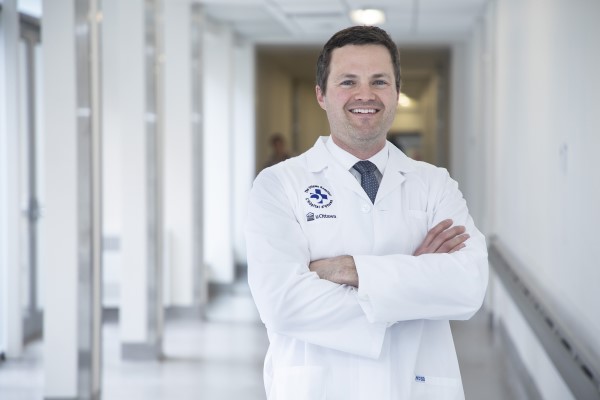
 A clinical trial led by Dr. Daniel McIsaac shows that a structured exercise and nutrition program before surgery (prehab) can improve recovery, but barriers remain.A large clinical trial published in JAMA Surgery shows that prehabilitation (also called prehab) can reduce disability after surgery in older adults with frailty, provided they are able to fully take part in the prehab program.
The trial, led by researchers at The Ottawa Hospital and the University of Ottawa, enrolled 847 older adults living with frailty from 13 surgical centres across Canada. Half were randomized to receive a structured home-based prehab program, focused on exercise and nutrition, for at least three weeks before surgery. The other half (control group) were provided with publicly available guidelines for physical activity and healthy eating.
Participants who completed at least 75 per cent of the prehab exercises had significantly lower levels of disability after surgery, although the overall results showed no difference in surgery-related complications or disability.
“This study shows that older adults with frailty who have enough time before surgery, along with the internal and external support to fully engage in a prehab program, are likely to experience a better recovery and less disability after surgery,” says Dr. Daniel McIsaac, anesthesiologist and senior scientist at The Ottawa Hospital and Clinical Research Chair in Perioperative Innovation at the University of Ottawa. “The study also shows that we need to continue to optimize and integrate prehab programs so that everyone can fully participate and ultimately benefit.”
The prehab program in this study, which was designed with input from experts and patient partners, provided patients with a personalized, home-based exercise and nutrition program. This included instructional exercise videos, an elastic band for strength training, a pedometer to track steps, coupons for protein supplements and calls from a prehab coach at least once per week.
Patients experienced meaningful benefits from prehab
 “A cancer diagnosis is never easy, and I can’t imagine what my recovery would have been like without this program,” says Christopher Wanczycki, who joined the study in 2021.Many patients who participated in the prehab arm of the trial reported meaningful benefits. Christopher Wanczycki joined the trial in November 2021, about two months before he was scheduled for cancer surgery at The Ottawa Hospital.
“A cancer diagnosis is never easy, and I can’t imagine what my recovery would have been like without this program,” says Christopher. “My surgery was on a Monday. By Wednesday, I could sit in a chair to eat lunch. On Thursday, I had dressed myself and was up at the nursing station trying to check myself out. By Friday, I was climbing the stairs at home. That would not have been possible without the prehab program.”
Prehab addresses major health care challenge
More than 300 million surgeries are performed around the world each year. Unfortunately, more than 20 per cent of major surgery patients suffer from complications after surgery, which can increase the length of hospitalization and delay recovery. Older people with frailty face the greatest risk.
A major review of prehab clinical trials around the world, published in January 2025, confirmed that prehab may be able to reduce complications and length of hospitalization after surgery, while also improving quality of life and physical recovery.
Prehab is increasingly being incorporated into health care, but questions remain about how best to do this.
The Ottawa Hospital’s Aging Innovation In Perioperative Medicine & Surgery (AIMS) Research Group, led by Dr. McIsaac, is already using the latest research results in a new study, designed to increase the ability of all patients to participate in prehab. Their STRIVE trial is currently enrolling adults from across Canada in a new virtual prehab program, which includes exercise, nutrition and psychosocial support, assisted with an online platform. If you’d like to learn more, please reach out to the team at strive@toh.ca or 1-877-372-7316.
Media contact
Jenn Ganton
Director, Communications and Public Relations
Ottawa Hospital Research Institute
613-614-5253
jganton@ohri.ca
Full reference: Home-based prehabilitation for older surgical patients with frailty: a pragmatic, multicenter randomized controlled trial. Daniel I. McIsaac; Susan Lee, MD; Dean Fergusson; Chelsia Gillis; Rachel G. Khadaroo; Amanda Meliambro; John Muscedere; Antoine Eskander; Husein Moloo; Gregg Nelson; Tarit Saha; Rosaleen Chun; Pablo E Serrano; Duminda N. Wijeysundera; Monica Taljaard; PREPARE Trial Investigator Group. JAMA Surgery. 4 Dec 2025.
Funders: Canadian Institutes of Health Research, Ontario Ministry of Health’s Innovation Fund, University of Ottawa.
Cores: Ottawa Methods Centre
The Ottawa Hospital (TOH) is one of Canada’s top learning and research hospitals where we are guided by our vision to provide the world-class and compassionate care we would all want for our loved ones. Our multi-campus hospital, affiliated with the University of Ottawa, is home to the Regional Trauma Centre and Cancer Centre, and to discoveries that are adopted globally. Backed by generous support from the community, we are focused on reshaping the future of health care to improve the health of our diverse population of patients from Eastern Ontario, Western Quebec, and Nunavut. For more information, visit ohri.ca.
The University of Ottawa is home to over 50,000 students, faculty and staff, who live, work and study in both French and English. Our campus is a crossroads of cultures and ideas, where bold minds come together to inspire game-changing ideas. We are one of Canada’s top 10 research universities—our professors and researchers explore new approaches to today’s challenges. One of a handful of Canadian universities ranked among the top 200 in the world, we attract exceptional thinkers and welcome diverse perspectives from across the globe. www.uottawa.ca

